

What LPs Get Wrong About Creator & Media Credit
Why the skepticism is understandable, and why it's wrong

Welcome back to Attention Capital
Over the past year, we have built this argument piece by piece. Attention behaves like capital. It can be measured, collateralized, and priced. Retention is duration. Habit is yield. Community is creditworthiness. In “How to Underwrite Attention,” we laid out the mechanics: the Four Layers of diligence, the stress tests, the decision tree that separates bankable attention from borrowed hype. In “The Case for Non-Dilutive,” we made the argument that the best borrowers in this market want credit, not equity.
The theory is settled. The frameworks exist. The deals are starting to happen.
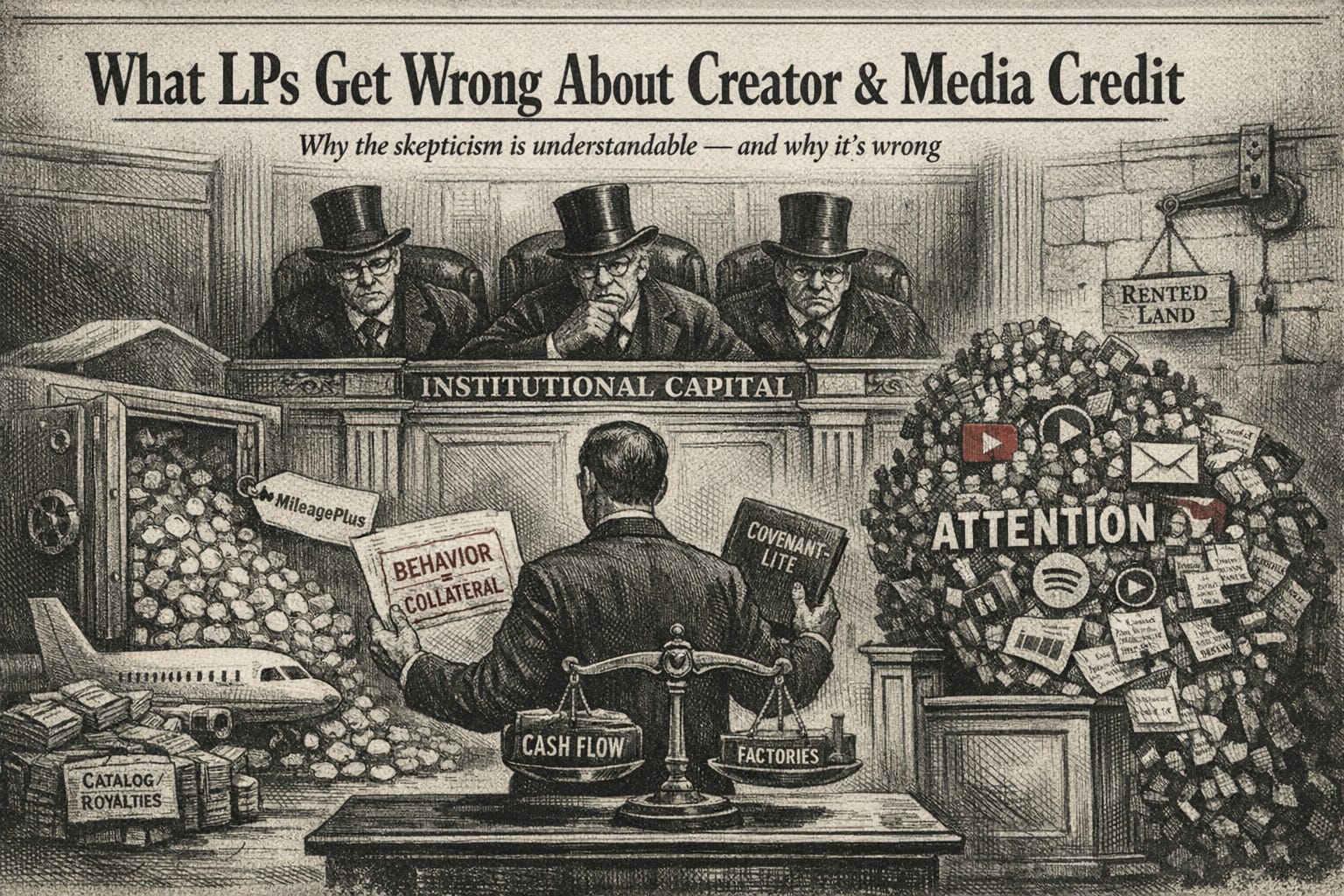
But sit across from institutional capital and five objections surface like clockwork. They sound reasonable. A few are even partially right. But they reveal something important: who has done the work to understand what’s being underwritten, and who is still running on pattern recognition from the last cycle.
This piece is about those objections. Not to dismiss them, but to answer them properly. Because the skepticism is understandable. And it’s also wrong.
The objection reveals more about the objector than the opportunity.
Objection One: “It’s Not a Real Asset”
The objection assumes collateral must be physical. Modern credit has priced behavior for decades.
This objection tells you the most about who you’re talking to. When an LP says attention isn’t a real asset, they usually mean they can’t touch it. No factory. No fleet. No inventory a bankruptcy court could liquidate.
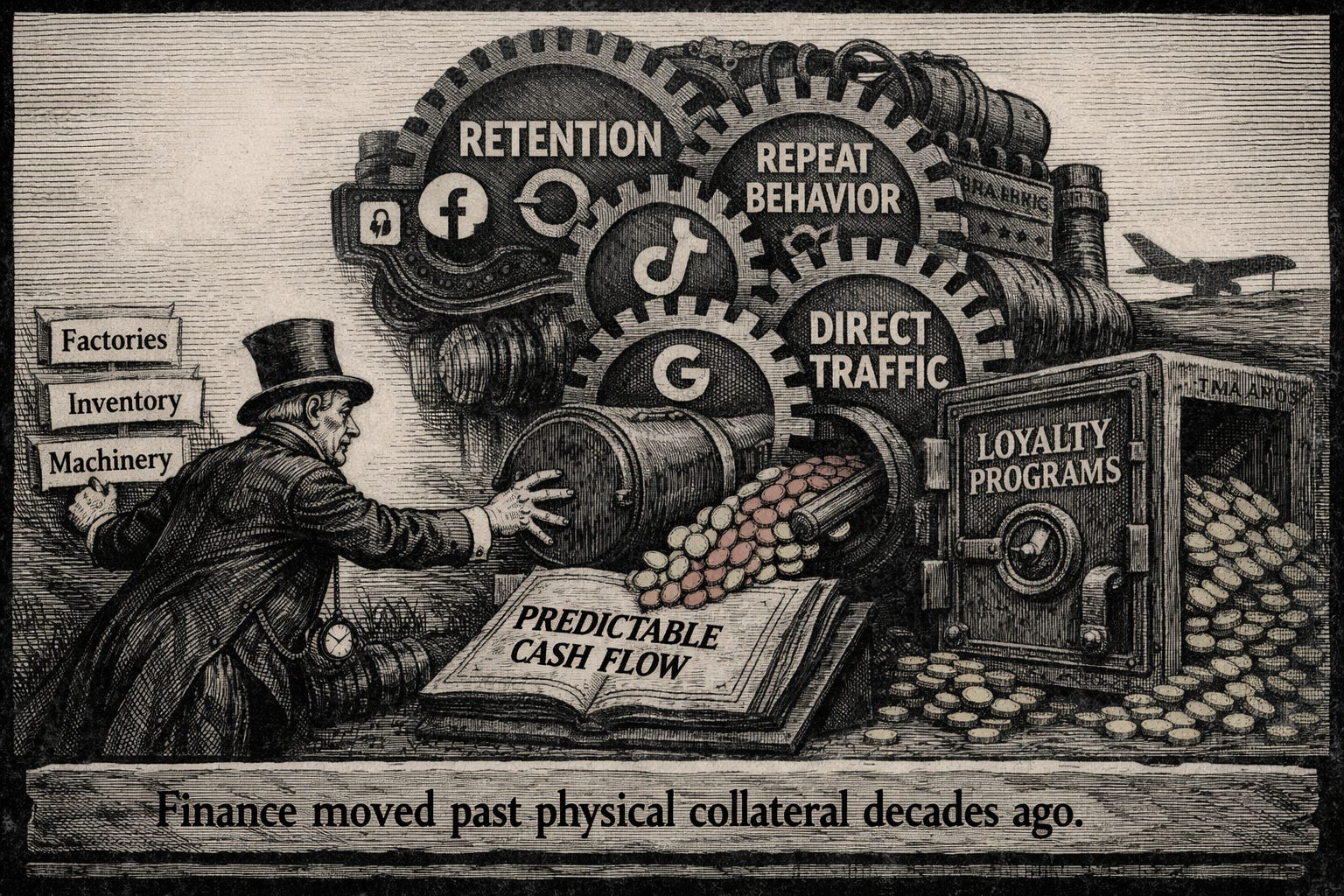
The objection reveals a definition of collateral frozen around 1985. Finance moved past physical assets decades ago. The leveraged loan market didn’t scale to over a trillion dollars by lending against manufacturing equipment. It scaled by lending against cash flow. The vast majority of U.S. leveraged loans are now covenant-lite, meaning lenders lean on borrower performance rather than fixed-asset tests. That’s behavioral underwriting. It just doesn’t call itself that.
Now look at what’s already been accepted as “real” collateral.
In 2020, United Airlines raised $6.8 billion secured against its MileagePlus loyalty program.
Stop and think about that for a moment. The planes were grounded. The routes were suspended. Demand had collapsed so completely that the airline industry was burning through cash faster than at any point in commercial aviation history. United’s core product, flying people from one place to another, had effectively ceased to exist.
And yet lenders were willing to underwrite billions against a system that, on the surface, consisted of points, status tiers, and consumer preference. Abstract numbers in a database that people accumulated by spending money on credit cards and obsessing over whether they’d hit Premier Gold by December.
Why? Because the behavior was durable. People earn miles even when they’re not flying, through credit card spend, through partner purchases, through the grinding accumulation that has turned millions of Americans into amateur loyalty-point accountants. People chase status. People redeem. The pandemic might ground the planes, but it didn’t stop people from buying things with their United credit card.
The loyalty program had decoupled from the core product. It behaved like infrastructure. The cash flow profile, driven by credit card partnerships and redemption patterns, was predictable enough to model, stress, and collateralize. MileagePlus generated billions in annual revenue regardless of how many planes were in the sky.
American did the same thing, ultimately securing roughly $10 billion through its AAdvantage program. These weren’t desperate moves by distressed companies. These were sophisticated financing structures that recognized behavioral assets as bankable. The bankers who structured those deals understood something that most LPs still haven’t internalized: when behavior is predictable enough, it becomes collateral. The planes were a distraction. The behavior was the asset.
Music royalties tell the same story, but with a plot twist that should embarrass every LP who’s ever said attention isn’t real.
For decades, music catalogs were treated as eccentric assets. Taste-driven. Volatile. Dependent on whether the kids still liked your songs. The conventional wisdom was that music was too weird, too idiosyncratic, too dependent on cultural whims to attract serious institutional capital.
Then Merck Mercuriadis showed up with Hipgnosis and started buying everything. Shakira’s catalog. The Red Hot Chili Peppers. Fleetwood Mac. Neil Young. He bought so aggressively and so publicly that the music industry started calling it a gold rush.
Then Blackstone arrived with a billion-dollar vehicle partnered with Hipgnosis. Then Concord started packaging royalties into asset-backed securities. Then KKR. Then Apollo. Then every pension fund and sovereign wealth fund that wanted yield in a zero-rate environment.
What changed wasn’t the music. The songs were the same songs they’d always been. What changed was that enough data accumulated to show the behavior was predictable.
Streams happen. Royalties flow. The songs people heard in 1985 still generate income in 2025 because they’ve become ambient. They’re woven into Spotify playlists that play in coffee shops. They’re in the background of TikTok videos. They show up at weddings and funerals and high school reunions. The listener isn’t actively choosing “Dreams” by Fleetwood Mac. They’re hearing it because it’s everywhere, and everywhere means royalties.
That continuation is the asset. The behavior pattern, not the song itself. Hipgnosis wasn’t buying music. They were buying the behavioral certainty that people would keep listening to certain songs forever.
And if you want proof that attention-based businesses can scale to institutional relevance, look at what’s happening in Japan.
COVER Corp, the company behind Hololive, and ANYCOLOR, which operates Nijisanji, are publicly traded companies built entirely on attention. They manage VTubers, virtual entertainers who stream, release music, sell merchandise, and perform live concerts to audiences that show up with the reliability of subscription revenue.
These aren’t niche curiosities. Both trade at multi-billion dollar valuations on the Tokyo Stock Exchange. Both are profitable. Both have diversified revenue: streaming, merchandise, concerts, licensing, and brand partnerships. Both have retention curves that would make any SaaS company jealous.
The “talent” in these businesses isn’t even human in the traditional sense. They’re animated characters voiced by performers. The IP belongs to the company. The audience relationship belongs to the company. If a performer leaves, the character can be retired or recast. The business continues.
If that sounds strange, consider what it proves: attention-based businesses are already trading on public markets, at multi-billion dollar valuations, with institutional investors holding the equity. The “it’s not a real asset” objection is arguing with the Tokyo Stock Exchange.
Attention works the same way. A subscriber who shows up every month is a coupon payment. A viewer who returns without prompting is working capital. A community that buys whatever you launch is collateral you can lend against.
The LP who says attention isn’t a real asset hasn’t updated their mental model since the pivot-to-video era. They’re looking for a factory when the factory is the audience.
The collateral is the behavior pattern, not the content.
Objection Two: “There’s No Collateral”
The objection conflates collateral with recovery. Cash-flow lending replaced asset-based lending a generation ago.
This is the sophisticated version of Objection One. The LP acknowledges that behavior can have value, but argues there’s nothing to secure the loan against. If the borrower defaults, what do you foreclose on? You can’t repossess an audience.
The objection makes sense if you think collateral means physical recovery. It makes less sense if you understand how modern credit works.
Let’s talk about cash-flow lending for a moment.
The shift from asset-based lending to cash-flow lending was one of the most important evolutions in leveraged finance. It happened because lenders realized the true collateral was a company’s ability to generate predictable performance, not the liquidation value of its equipment. A machine on the factory floor might fetch twenty cents on the dollar in a fire sale. A predictable cash flow stream services debt for years.
This is why enterprise value became the collateral for an entire generation of LBO financing. The collateral isn’t any single asset. It’s the going-concern value of the business, the cash-generating capacity of the operation, the behavior of customers who keep showing up.
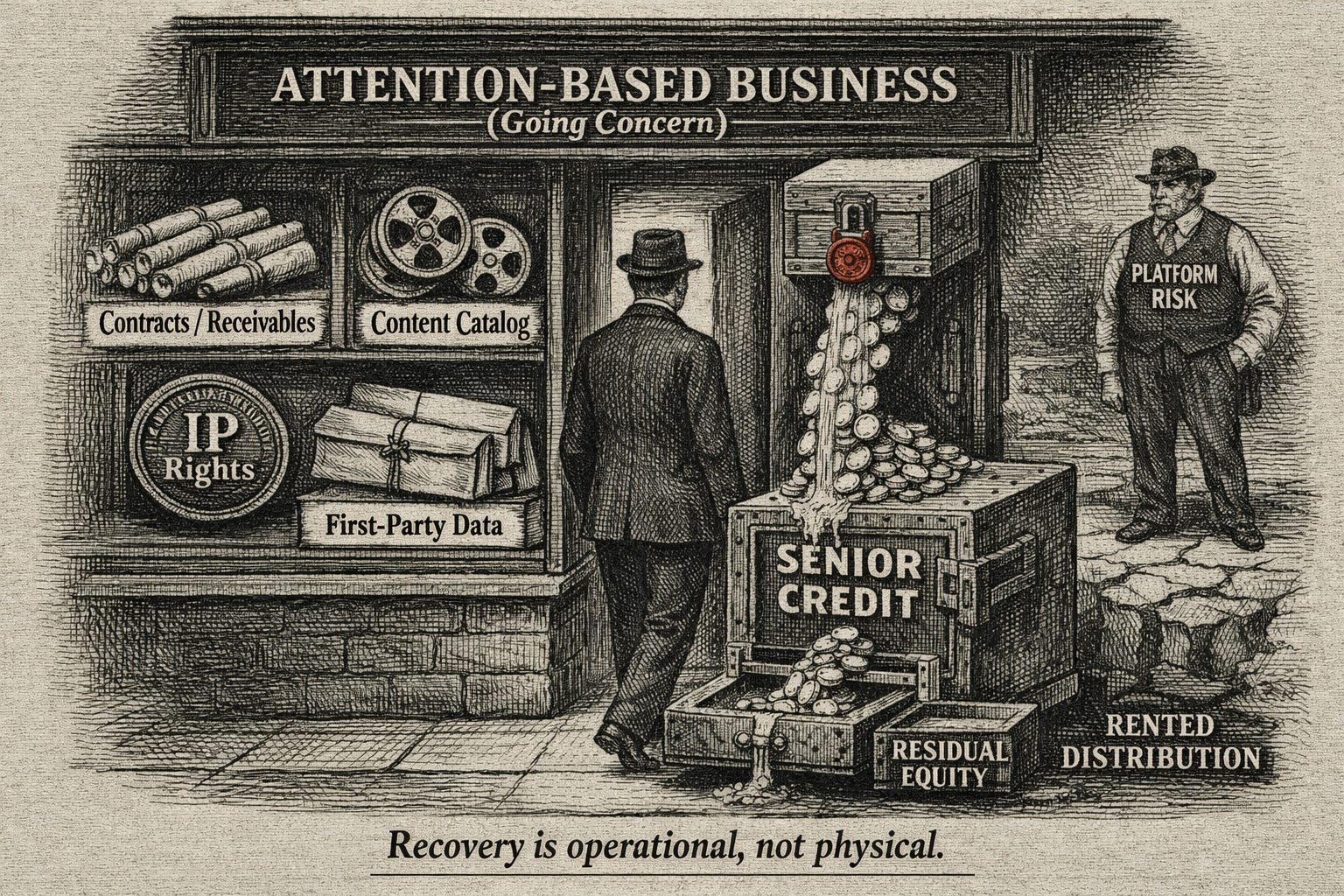
Creator and media credit works the same way. The collateral package in a well-structured deal includes:
Contracted revenue streams. Brand deals with minimums. Platform agreements with guaranteed rates. Licensing contracts with defined terms. These aren’t ephemeral. They’re receivables.
Intellectual property. Trademarks, formats, characters, catalog. A creator who has built a recognizable brand owns something. A production company with 200 titles in its library owns something. These assets have value independent of the founder’s daily involvement.
First-party data. Email lists with delivery history. SMS subscribers with opt-in proof. Community platforms with membership data. These aren’t just marketing assets. They’re audience relationships that can be valued and, in some structures, transferred.
Catalog value. Videos that still generate views three years after upload. Content that appears in search results and drives consistent traffic. This is the attention equivalent of a royalty stream, and it can be modeled with surprising precision.
Platform agreements. Revenue-share arrangements with YouTube, Spotify, or other distribution partners. These agreements have terms, and those terms have value.
The recovery story in a default scenario isn’t “foreclose on the audience.” It’s “step into the revenue streams, manage the IP, and either operate or sell the business as a going concern.” The operational controls exist: cash waterfalls that direct platform payments, lockbox arrangements, security interests in IP, step-in rights that allow a lender to manage the business through a transition. This isn’t hypothetical. It’s exactly how distressed media assets get worked out.
Here’s a useful frame: think about software-as-a-service businesses. What’s the collateral in a SaaS credit facility? Not the code, exactly. Not the servers, certainly. It’s the recurring revenue from customers who keep paying because switching costs are high and the product is embedded in their workflow.
Attention-based businesses have the same dynamics. The audience keeps returning because the habit is embedded. The revenue keeps flowing because the relationships are direct. The collateral is the cash-generating capacity of those relationships.
Covenant-lite is already the market. Lenders price behavior, not bolt inventory.
Objection Three: “Creators Are Flaky”
The objection conflates influencers with attention-based businesses. We finance infrastructure, not personalities.
This is the objection that reveals the deepest misunderstanding of what we do.
When an LP says creators are flaky, they’re usually imagining a 22-year-old with a ring light, a vague sense of their own importance, and a business model that consists entirely of “brand deals, I guess.” They’re imagining someone who might get bored, burn out, say something catastrophic on social media, or simply decide that making content isn’t fun anymore.
The objection is understandable. Some creators are flaky. Some creators are disasters waiting to happen. Some creators have audiences but no businesses.
But here’s the thing: we finance attention-based businesses, not influencers.
The distinction matters enormously.
An influencer is someone with reach who gets paid to say things. Brands rent their audience for a campaign. The transaction ends when the post goes live. There’s no infrastructure underneath. No diversified revenue. No catalog value. No business that exists independent of the next sponsorship check. Influencers are distribution channels you rent by the week.
An attention-based business is a company with multiple revenue streams, direct audience relationships, operational infrastructure, and assets that compound over time. The founder might have started as a creator, but what they’ve built is a media company. The personality is the front door, but the business runs whether they’re on camera that day or not.
Think about what separates the two.
An influencer with 2 million followers might generate $500,000 a year, almost entirely from brand deals that require their active participation. If they stop posting, the revenue stops. If they have a controversy, the brand deals evaporate. If they wake up one morning and decide they’d rather go to law school, the business ceases to exist. There’s no catalog. No owned audience. No recurring revenue. No business to underwrite. There’s just a person with a phone and a talent for getting people to watch them talk about products.
Now consider what a real attention-based business looks like.
A food creator has built something entirely different from the influencer model. She started making videos because she had a point of view on technique that existing content wasn’t serving. A few years in, the business has infrastructure: a newsletter with strong open rates, a product line with repeat purchase behavior, a back catalog that generates meaningful views from content published years ago, and a revenue mix that spans platform ads, products, licensing, and brand partnerships. No single stream dominates. No single platform controls her reach.
The business has value independent of whether she posts a new video tomorrow. The catalog generates views. The products generate repeat purchases. The newsletter generates opens. The licensing deals are contracted.
That’s a vertically integrated media and commerce business built around one person’s expertise and audience relationship.
The “creators are flaky” objection applies to the first example, not the second. And the entire point of rigorous underwriting is to tell the difference.
This is why the frameworks matter. The Four Layers of diligence exist precisely to separate businesses from personalities. When you examine retention curves, revenue quality, community strength, and platform risk, you’re not asking “Is this person charismatic?” You’re asking “Does this business generate durable cash flow?”
Personality risk is real, but it’s one input among many, not the whole underwriting. A creator who has built direct channels, diversified revenue, and catalog value has created something that can survive a bad quarter, a controversy, or even a step back from daily content production.
Here’s a pattern I’ve seen play out multiple times, anonymized but representative.
A mid-sized finance creator took a three-month hiatus for health reasons. Complete break. No new content. No social media presence. If you’ve internalized the “creators are flaky” objection, you’d predict collapse.
Here’s what happened: YouTube revenue dropped 15%, because the catalog kept generating views. People searching for explanations of 401(k) rollovers kept finding videos from 2021 and 2022. The newsletter maintained strong open rates because the creator had batched evergreen content before stepping away. Product sales increased slightly because the course was good, the testimonials were real, and the trust was already built.
The creator came back to a business that had bent but not broken. The audience was still there. The revenue had compressed but not collapsed.
That’s an attention-based business with structural resilience.
We finance attention-based businesses, not influencers.
And here’s the broader point: creators are just the canary in this particular coal mine.
As I argued in “Creators Are the Canary,” creators operate in the purest attention market. They face platform volatility, audience fragmentation, and revenue model shifts with no insulation. No agency smoothing outcomes. No distributor buffering demand. No enterprise contracts providing stability.
Because they face these pressures first, they’ve figured out the playbook first. Diversify revenue. Build direct relationships. Create catalog value. Own the audience relationship rather than renting it from platforms.
Overtime is a useful illustration of where this leads. The company started as a social-first sports media brand, posting highlight clips and original content that resonated with young audiences who weren’t watching ESPN. It could have stayed there, dependent on platform reach, vulnerable to algorithm changes.
Instead, it institutionalized. Overtime launched its own basketball league, Overtime Elite, which pays high school players to develop professionally while creating content. It built a merchandise operation. It expanded into original series and documentary content. The business now has infrastructure, recurring revenue streams, and assets that exist independent of any single platform or piece of content.
The personality, if you can call a brand a personality, opened the door. The infrastructure walked through it. The business became something that could survive platform volatility because it had diversified what attention meant and how it converted to revenue.
The best creators aren’t flaky. They’re the most battle-tested operators in the attention economy. They’ve survived algorithm changes that would have bankrupted traditional publishers. They’ve built businesses that traditional media companies envy.
Every modern company is becoming a media company. Some will rent attention. The good ones will bank it. We’re financing the ones who’ve figured out banking.
Objection Four: “It’s Too Small”
The objection mistakes current scale for terminal scale. Every asset class looked small before someone built the infrastructure.
This is the objection of someone who has never been early to anything.
The creator economy alone represents hundreds of billions annually and is projected to roughly double over the next several years. That’s before you expand the aperture to include the broader category of attention-based businesses: production companies with durable catalogs, digital publishers with owned audiences, niche media brands with loyal subscribers, consumer businesses built on direct audience relationships.
But market size arguments miss the point. Every asset class looked small before the infrastructure existed to scale it.
Let me tell you about the leveraged loan market in 1990.
Total volume was maybe $30 billion. The deals were bespoke. The documentation varied wildly. There were no standard terms, no indices, no secondary market to speak of. If you wanted to trade a loan, you called around and hoped someone wanted to buy it. Most institutional investors ignored the space entirely. Too small. Too weird. Not worth the effort to develop expertise in something so niche.
Then the LSTA got founded. Documentation standardized. Trading protocols emerged. Indices were created. Rating agencies developed frameworks. And suddenly the “niche” became a $1.55 trillion market that anchors institutional portfolios around the world.
The investors who developed the literacy early, who understood how to underwrite leveraged credits before the frameworks were fully built, made fortunes. The investors who waited for the market to mature enough to be “safe” paid up for access and inherited frameworks someone else had designed.
Music royalties tell the same story, compressed into a shorter timeframe.
Ten years ago, institutional capital largely ignored music catalogs. Too small, they said. Too weird. The people buying catalogs were specialized funds and music industry insiders. The institutional allocation committees couldn’t get comfortable with an asset that depended on whether teenagers would still like Fleetwood Mac.
Then Hipgnosis went on a $2 billion buying spree and suddenly the narrative changed. Blackstone launched a billion-dollar vehicle. Concord started securitizing royalties. KKR backed a catalog acquisition platform. Apollo got involved. Every pension fund that needed yield in a zero-rate environment started asking how they could get exposure to music royalties.
The market that was “too small” became one of the most sought-after alternative asset classes of the 2020s. The LPs who got in early set the terms. The LPs who waited paid up for access.
Attention-based credit is at the same inflection point. The market is small relative to what it will become. That’s not a warning sign. That’s the definition of an opportunity.
The LPs who wait for the market to be “big enough” are the LPs who will miss the part of the curve where the terms are most favorable. Early movers in any asset class get to set the standards. Everyone who comes later inherits the framework someone else built.
Every asset class looked too small before someone built the infrastructure to scale it.
Objection Five: “We’ve Seen Media Deals Blow Up”
The objection conflates equity failures with credit risk. The graveyard is real. The lessons are different from what most people think.
This objection has teeth. The graveyard is real, and the headstones are expensive.
Vice Media, valued at $5.7 billion at peak, filed for bankruptcy in 2023 and sold for a fraction of that. At its height, Vice was supposed to be the future of media. A generation of young people trusted Vice in a way they didn’t trust CNN or the New York Times. The company had a cable channel, documentary series, digital properties with hundreds of millions of monthly visitors, and a brand that felt authentically rebellious. Disney invested. TPG invested. The valuation kept climbing until it didn’t.
BuzzFeed won a Pulitzer Prize and died anyway. Think about that for a moment. The company produced journalism good enough to win the industry’s highest honor, and it still couldn’t sustain a business model. The news division shut down. The stock cratered from a post-SPAC high of around $10 to under a dollar. A company that pioneered viral content and seemed to understand the internet better than anyone else couldn’t figure out how to make money understanding the internet.
Mic, which raised $60 million to pursue the millennial market with serious news coverage, sold to Bustle Digital Group for roughly $5 million. A 92% loss of capital.
Little Things, which had one of the largest video audiences on Facebook, reaching tens of millions of people with feel-good content about dogs and babies and heartwarming reunions, shut down when Facebook changed its algorithm. One platform decision, and the company ceased to exist.
The pivot-to-video casualties alone could fill a business school case study in capital destruction. Facebook told publishers that the future was video. Publishers believed them. They fired writers who knew how to generate traffic. They hired video producers who knew how to make content that looked good in a feed. They rebuilt entire strategies around Facebook’s promise of a video-first future.
Then Facebook changed its mind. Zuckerberg decided the News Feed should prioritize friends and family over publishers. Traffic cratered. Ad revenue vanished. Companies that had raised hundreds of millions of dollars evaporated in months because they had built their entire distribution strategy on the assumption that Facebook would keep its promises.
So when an LP says “we’ve seen media deals blow up,” they’re not wrong. They’ve seen spectacular destruction of capital. They’re understandably cautious.

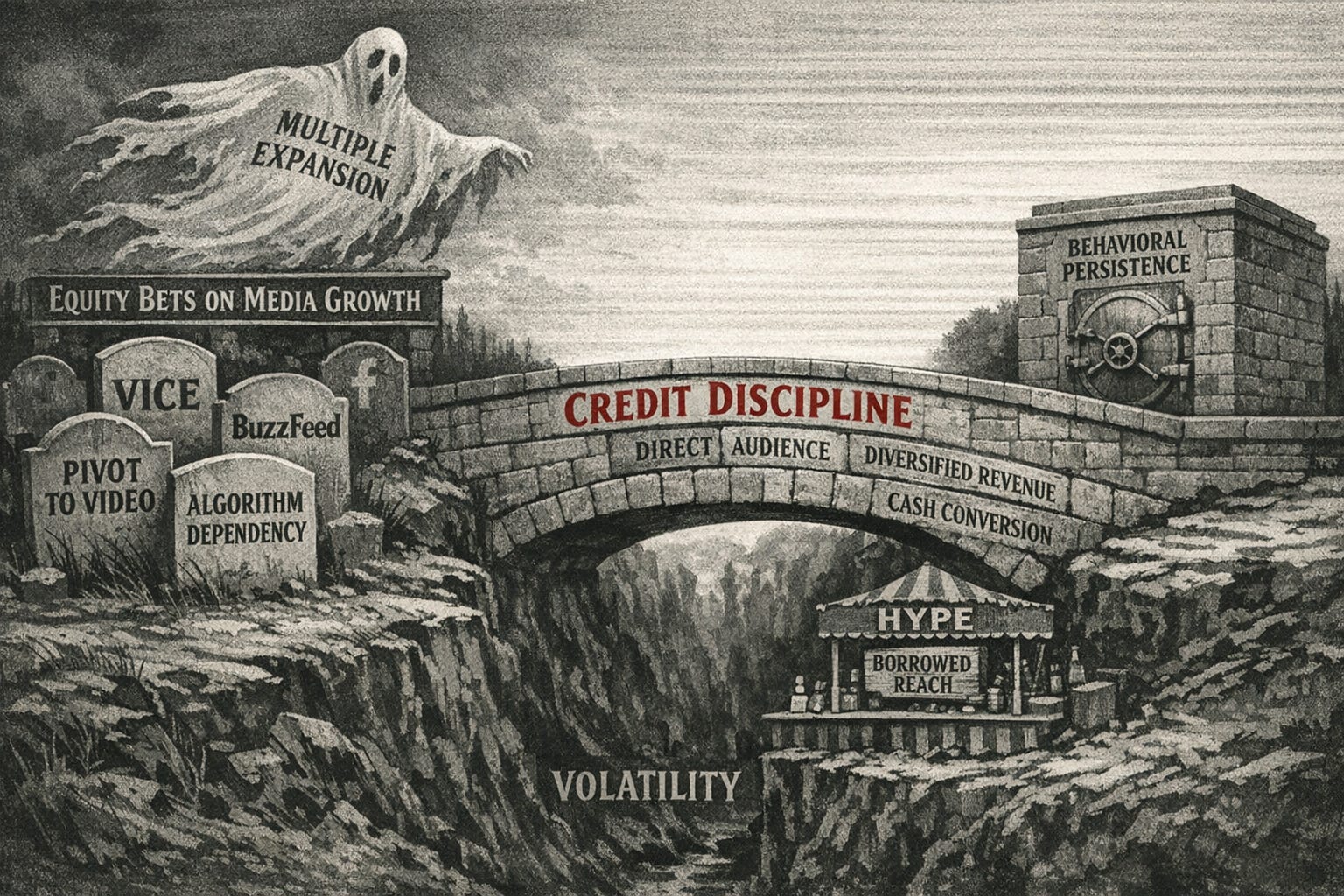
But here’s what that objection misses: those were equity deals betting on growth trajectories. Credit deals underwrite cash flows. The distinction is everything.
Equity investors in Vice were betting it could become a global media conglomerate worth tens of billions. The thesis required massive audience growth, successful international expansion, and eventually either an IPO or a strategic sale at a huge multiple. When the growth didn’t materialize, the equity became worthless. That’s how equity works. You’re buying optionality on an outcome. When the outcome doesn’t happen, the option expires worthless.
Credit asks a different question: will this business generate enough cash to service debt and return principal? That’s not conviction about a growth trajectory. That’s confidence in a cash flow pattern.
A credit analysis of Vice would have revealed the problems: revenue concentration in advertising, platform dependency for distribution, a cost structure built for a company twice its size. These are exactly the factors that make a business unsuitable for debt financing. Credit discipline reveals what equity optimism obscures.
BuzzFeed tells a similar story. The equity thesis was about building a new kind of media company. When the growth didn’t materialize, the equity died. But a credit underwriter would have flagged the real problem immediately: platform concentration as a walk-away risk. The audience was Facebook’s audience, not BuzzFeed’s. No email list of consequence. No subscription revenue. No direct channel to reach readers. That’s not collateral. That’s a dependency that can be revoked without notice.
The Athletic tells the opposite story. Founded in 2016, it built a sports news business on a simple premise: people would pay for quality journalism if you gave them a reason to. No advertising. No algorithmic dependency. Just subscriptions.
When the digital media bloodbath hit in 2022 and 2023, The Athletic didn’t collapse. It got acquired by the New York Times for $550 million. Why? Because it had something the others didn’t: direct subscriber relationships. The audience paid. The audience provided email addresses. The audience could be reached without platform permission.
The Athletic survived the same macro conditions that killed its peers because it had structural resilience built into the business model. That’s the difference credit analysis reveals.
The media deals that blew up share common characteristics: equity structures betting on growth, platform-dependent distribution, cost structures that required scale to work, and business models that converted attention into cash inefficiently or not at all.
Credit-worthy attention businesses look different: direct audience relationships, diversified revenue, catalog value, cost structures that work at current scale, and cash conversion you can model.
Credit discipline reveals what equity optimism obscures.
The Proof Points Hidden in the Failures
If you want to understand why attention-based credit works, study the companies that almost got it right. Their failures are more instructive than most successes.
Jellysmack reached a peak valuation of nearly $2 billion on a thesis that sounded bulletproof: creators have valuable back catalogs generating views in perpetuity. Buy those catalogs. Optimize distribution across platforms. Monetize the long tail.
They scaled aggressively, hired hundreds of people, and built a content optimization machine that could reformat videos for every platform. The pitch decks were beautiful. The growth charts were vertical.
Then the yield curve broke.
Facebook deprioritized video. CPMs compressed. And Jellysmack discovered they had securitized someone else’s platform risk. They didn’t own the platforms. They didn’t set the CPMs. When the platforms changed their minds, Jellysmack’s models broke.
By 2024, the company had reduced headcount by more than 25% and pivoted toward white-label services. The lesson isn’t that creator financing failed. The lesson is that Jellysmack’s specific model failed because it took platform risk it couldn’t manage.
Spotter took a different approach. By late 2024, they had deployed over $940 million across more than 900 YouTube channels. The headline numbers looked similar to Jellysmack’s. The philosophy was different.
Spotter didn’t buy catalogs and try to optimize them. They underwrote behavior. Their models predicted future viewership based on historical patterns, retention curves, and content consistency. They looked for creators whose audiences demonstrated behavioral persistence, where tomorrow would look roughly like yesterday.
It worked, mostly. The portfolio performed through the ad market fluctuations of 2022 and 2023 because the underlying behavior was durable. But the model also revealed its limits: it worked best for established, YouTube-native creators with strong catalog performance. Less well for volatile creators or anyone dependent on algorithmic discovery rather than a loyal base.
Put Jellysmack and Spotter side by side, and the lessons crystallize:
Jellysmack bet on operational improvement. Buy the catalog, redistribute it better, capture the arbitrage between what the creator was earning and what the content could earn with professional optimization. The model required them to be smarter than the platforms about content distribution. When platform dynamics shifted, the arbitrage disappeared. They were playing someone else’s game and lost when the rules changed.
Spotter bet on behavioral persistence. Identify creators whose audience patterns were already predictable, advance capital against those patterns, let the creators keep doing what they were already doing. The model required only that behavior continue, not that anyone optimize it. They weren’t trying to beat the system. They were trying to underwrite the system.
The market taught us which thesis survives stress.
Jellysmack and Spotter proved the demand. What’s missing is the infrastructure.
Here’s what both companies proved, even through their different outcomes: the market exists. Creators want capital. The attention generates real cash flow. The behavior can be modeled with reasonable accuracy. The demand side is solved.
What the early entrants also revealed is what’s missing: proper underwriting infrastructure, risk-tiering systems, documentation standards, recovery frameworks. The deals happened, but they happened bespoke. Each one required reinventing the wheel. Each negotiation started from scratch. There were no industry standards for what a creator credit facility should look like, no benchmarks for advance rates by tier, no templates for covenant packages that lawyers could pull off a shelf.
The next iteration requires something more systematic. Scoring frameworks that translate attention metrics into credit tiers, so that a Prime-tier creator and a Volatile-tier creator get offered different structures without anyone having to argue about it. Standard collateral packages that lawyers don’t have to invent from first principles every time. Covenant structures that reference behavioral metrics, things like retention rates and platform concentration, not just financial ratios. Secondary market infrastructure so portfolios can trade, so lenders can manage exposure, so the market can develop liquidity.
And most importantly, it requires underwriters who can read both the retention curve and the credit agreement. Who can look at a creator’s YouTube analytics and see the same patterns that a credit analyst sees in a cash flow model. Who can translate between worlds that don’t usually talk to each other.
That combination is rare. Finance professionals have never analyzed a creator business. They don’t know what a good open rate looks like, or how to interpret the difference between algorithmic discovery traffic and search traffic, or why a 40% catalog-to-new-content ratio matters. Media professionals have never structured a covenant package. They don’t know what an advance rate means, or how to think about recovery scenarios, or why platform concentration is a credit risk rather than just a business risk.
The opportunity is in the gap. The first lenders who develop fluency in both languages will set the terms for the entire market.
What the Objections Actually Reveal
Here’s what I’ve noticed after years of having these conversations: the objections cluster predictably by background.
LPs who came up through traditional private credit ask about collateral and recovery. They’re applying frameworks that worked for manufacturing businesses and real estate. The frameworks are good. The application needs updating.
LPs who came up through venture capital ask about the growth trajectory and exit path. They’re used to underwriting optionality, not cash flow. When you explain that the return comes from yield rather than multiple expansion, they sometimes struggle to fit it into their mental model.
LPs who came up through media and entertainment have the opposite problem. They understand the attention dynamics intuitively. What they often lack is the structured credit vocabulary. They know which creators have durable audiences. They don’t know how to translate that into covenant structures and advance rates.
The objections, in other words, reveal the objector’s training. They’re applying the frameworks they know to an asset class that requires hybrid literacy.
But here’s what makes the objections increasingly hard to sustain: the examples keep multiplying.
Consider Dhar Mann Studios. Dhar Mann started making motivational videos on Facebook in 2018. The content was earnest, the production values were modest, and the traditional media industry ignored it entirely. Seven years later, his studio generates billions of views annually across platforms.
More importantly, the business has evolved beyond the founder. There’s a writers room. A production facility in Los Angeles. A roster of recurring actors who have become recognizable faces to the audience. A format and tone that’s replicable. A content library with thousands of videos.
If something happened to Dhar Mann tomorrow, the studio would likely continue. The infrastructure exists. The team exists. The format exists. The audience relationship has been institutionalized into something bigger than any single person. That’s a media company that grew out of one person’s creative vision but now stands on its own.
Or look at the Sidemen, the UK collective that started as gaming YouTubers and has become something impressive. They’ve launched a restaurant chain. They’ve built an apparel brand. They organize charity football matches that sell out stadiums. Their content spans multiple channels with different hosts and formats.
The group has been together for over a decade. Members have come and gone. Individual channels have their own trajectories. But the collective entity, the Sidemen as a business, has diversified and institutionalized to the point where it’s not dependent on any single member showing up to record on any given day.
Mythical Entertainment, built by Rhett McLaughlin and Link Neal, tells the same story. What started as two guys talking at a desk has become a company with multiple shows, multiple hosts, a studio facility, and business lines that generate revenue independent of whether Rhett and Link are on camera. Mythical Kitchen, one of their spinoff properties, has its own audience, its own hosts, and its own commercial partnerships.
These aren’t outliers. They’re what attention-based businesses look like when they mature. The personality opens the door. The infrastructure walks through it. The business becomes something that can be operated, scaled, and yes, financed.
The LP objections describe the opportunity as much as they describe the risk.
Every emerging asset class goes through this phase. The people who succeed are the ones who develop fluency in the new language first. In mortgage-backed securities, it was the traders who understood both fixed income and residential real estate. In leveraged loans, it was the bankers who understood both credit and private equity dynamics. In music royalties, it was the investors who understood both catalog economics and financial engineering.
Attention-based credit requires the same synthesis. You need to read a balance sheet and a retention curve. You need to understand covenant math and community dynamics. You need to speak finance and culture fluently.
The skepticism is understandable. It’s also the opportunity.
The skepticism from LPs is understandable because the literacy is rare. Most credit committees have never analyzed a creator business. They don’t know what questions to ask. They don’t know what good looks like.
But that’s exactly why the opportunity exists. If everyone already understood how to underwrite attention, the market would be efficient and the returns would be compressed. The alpha is in the translation.
The Questions That Remain
I won’t pretend the infrastructure is complete. It’s not. The market is young. The standards are emerging. Real questions remain.
What does recovery look like when the collateral is behavioral?
We know, roughly, how to work out a distressed manufacturing company. Liquidate the equipment. Sell the real estate. Pursue receivables. The playbook exists.
Distressed attention assets are different. The value is in the going concern, not the liquidation. A catalog has value, but only if someone operates it. An audience relationship has value, but only if someone maintains it.
This probably means recovery strategies that look more like operational turnarounds than fire sales. Step into the business, stabilize the cash flows, and either run it or sell it to an operator who can. The frameworks for this exist in other contexts. They just need to be adapted.
How do you build indices when attention metrics vary so much across platforms?
A million YouTube subscribers is not the same as a million TikTok followers is not the same as a million podcast downloads. The normalization math is genuinely difficult.
But it’s not impossible. Credit markets have solved similar problems before. The LSTA created standards for leveraged loans that allowed disparate deals to be compared and traded. The music royalty market developed valuation frameworks that work across different genres and eras.
Attention indices will require similar innovation. Category-specific benchmarks. Platform-adjusted metrics. Composite scores that weight durability, conversion, and community differently depending on business model.
What regulatory frameworks emerge as this scales?
Attention-backed securities will eventually face disclosure requirements. Probably not the same ones as traditional ABS, but something. The question is who shapes those frameworks. Industry participants who understand the asset class, or regulators working from analogy to products that don’t quite fit.
The best outcome is proactive standardization. Establish best practices before the regulators arrive. Create the transparency and documentation norms that institutional capital requires. Build the infrastructure that makes the market legible to participants and overseers alike.
How do you handle personality risk at scale?
A creator is not a corporation. Key-person risk is real in ways that traditional credit doesn’t often face. Burn out. Public controversy. Health issues. A simple decision to stop creating.
Some of this is mitigable through structure: catalog value that persists, team infrastructure that can continue operations, IP rights that can be licensed or sold. Some of it requires acceptance that personality-driven businesses carry risks that personality-independent businesses don’t.
The answer is probably risk-tiering. Businesses with strong catalog value and operational infrastructure can support more leverage. Businesses that depend heavily on continuous creator participation require different structures, maybe revenue-share rather than term debt, maybe shorter duration, maybe smaller advance rates.
The frameworks for thinking about this exist. What’s needed is calibration.
The theory is done. The infrastructure is being built.
Why This Matters Now
Here’s what I know after twenty-five years of watching capital markets evolve across finance, media, and technology:
The LPs who wait for perfect clarity never get the best terms. The LPs who develop conviction early, based on rigorous analysis rather than pattern-matching from the last cycle, are the ones who shape the market.
The objections I’ve outlined are understandable. They come from applying proven frameworks to unfamiliar territory. That’s rational. That’s prudent. And it’s also how opportunities get missed.
Attention is already being priced as collateral. The airline loyalty deals proved it. The music catalog deals proved it. Jellysmack and Spotter proved demand exists among borrowers. What’s being assembled now is the institutional infrastructure that turns ad hoc deals into a scalable market.
The LPs who engage now will set the terms. The LPs who wait will inherit whatever framework someone else built.
The call here is to update the diligence frameworks so the questions match the asset class.
The skepticism is understandable. The opportunity is in being right before the skepticism fully dissolves.
If you remember one thing from this piece, remember this:
Equity bets on attention failed because they priced upside. Credit works when it prices behavior.
That’s the whole difference. Vice and BuzzFeed were equity bets on growth trajectories. The airline loyalty deals and music catalog financings were credit underwritings of behavioral persistence. One category produced a graveyard. The other produced a new asset class.
The frameworks exist now. The underwriting methodology exists. The deals are being done. The question isn’t whether attention is financeable. It already is. The question is who develops the literacy to underwrite it properly, and who sets the terms for everyone who comes later.
There are two kinds of LPs reading this.
The first kind will pattern-match to the last cycle, see “creator” and “media,” and file this under “too weird, too early, too risky.” They’ll wait for the market to be de-risked by others. They’ll inherit whatever framework someone else built. That framework might work for them. It definitely won’t be optimized for them.
The second kind will recognize that every objection in this piece is an objection they’ve heard before about other asset classes that are now mainstream. They’ll do the work to understand what’s being underwritten. They’ll develop the hybrid literacy that lets them read both retention curves and credit agreements. And they’ll set the terms for the market that’s forming.
The alpha is in the translation. It always has been.
Why Subscribe
Because the gap between attention and capital is closing, and most people haven’t noticed.
Every week, Attention Capital breaks down where that gap is narrowing: the deals getting done, the metrics being tracked, the structures being invented. From creator financing to media M&A to the emerging infrastructure for cultural credit markets.
If you work in finance, this is how you learn to underwrite the next asset class. If you work in media or tech, this is how you understand what makes attention bankable. If you’re an LP evaluating the space, this is how you develop the literacy to ask the right questions.
For more on attention as an asset class, visit attncap.com.
This is an extremely thorough and logical explanation of this opportunity for both now and later. Well done.