

The Largest Attention Allocator In The World
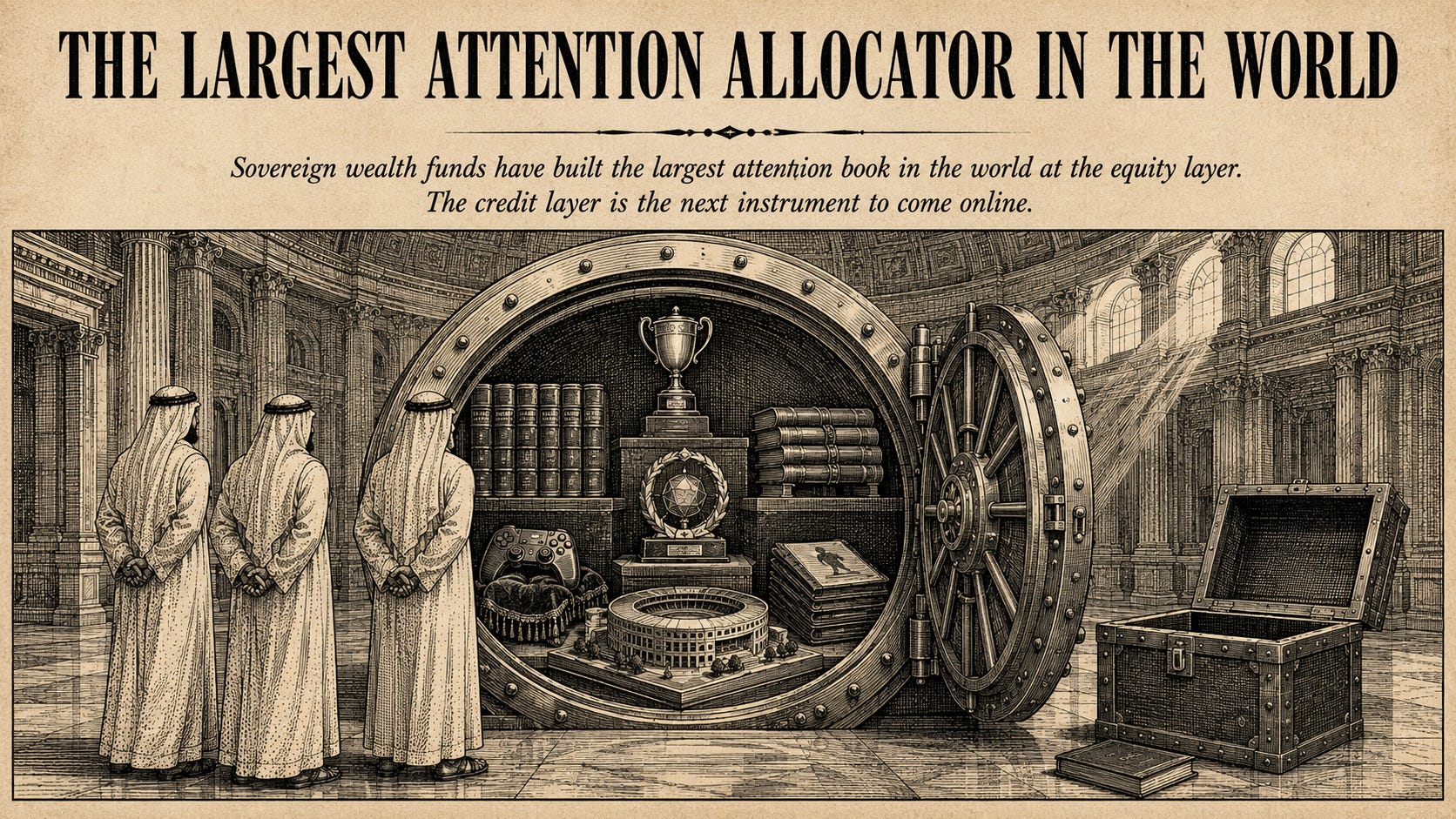
Sovereign wealth funds have built the largest attention book in the world at the equity layer. The credit layer is the next instrument to come online.

Welcome back to Attention Capital.
In the spring of 2023, a deal closed in Los Angeles that the gaming press treated as a gaming story and the finance press treated as a cross-border M&A story. Savvy Games Group, the gaming holding company wholly owned by Saudi Arabia’s Public Investment Fund, acquired Scopely for $4.9 billion. Two years later, Scopely closed the $3.5 billion acquisition of Niantic’s games division, including Pokémon GO. In September 2025, PIF, Silver Lake, and Affinity Partners agreed to take Electronic Arts private at $55 billion, with PIF rolling its 9.9% stake into a 93.4% controlling position and contributing roughly $29 billion in new cash.
In the same window, PIF funded LIV Golf at more than $5.3 billion through the 2026 season, acquired Newcastle United at a £305 million enterprise value in October 2021, built the Esports World Cup in Riyadh to a $71.5 million prize pool, and allocated SR142 billion (roughly $38 billion) to the gaming sector under the Savvy mandate. The Qatar Investment Authority runs a parallel book. The Abu Dhabi vehicles run a third. Mubadala alone deployed $29.2 billion across 52 transactions in 2024, then pledged a $10 billion alliance into Mark Walter’s TWG Global in April 2025, giving Abu Dhabi exposure to the Dodgers, the Lakers, and Chelsea FC inside a single holding company.
Add it up. The Gulf sovereigns have committed more than $100 billion of disclosed attention capital across gaming IP, league rights, club ownership, live events, and media holdings over the past four years. Once EA closes, PIF’s disclosed gaming exposure alone clears $80 billion.
The sovereign wealth funds of the Gulf are the largest single allocator class into attention assets in the world.
Every position is equity. None of it is credit yet.
That gap is the entire piece.
Sovereign wealth funds buy attention as long-duration infrastructure. The investment profile (multi-decade hold, sovereign-risk tolerance, cash yield secondary to strategic positioning) is the cleanest LP profile for senior secured attention paper. The same capital that funded LIV Golf, Newcastle United, Scopely, Niantic, and the Esports World Cup is structurally calibrated to anchor rated paper against league rights, gaming IP, music catalogs, and live-event cash flows at tighter spreads and longer durations than any other LP class. The credit wrapper is the next instrument to come online. The first sovereign-anchored attention credit vehicle prints the comp for the next twenty years of LP allocation into the asset class.
For the Attention-Constrained
The position: Gulf sovereign wealth funds have committed more than $100 billion of disclosed attention capital across gaming IP, league media rights, club ownership, live-event infrastructure, and music-adjacent media positions over the last four years. PIF crossed $1 trillion in AUM in 2025, at approximately $1.15 trillion. QIA carries roughly $524 billion. Mubadala, ADQ plus ADIA aggregate over $1.5 trillion in Abu Dhabi capital. The Gulf sovereign cohort sits comfortably north of $3 trillion in deployable capital. The entire U.S. private credit market is roughly $1.7 trillion.
The Gulf cohort is structurally larger than the buyer base credit has spent thirty years assembling on the music side.
The structural read: Sovereign wealth funds carry the longest hold horizons and the lowest cost of capital of any LP class in private markets. The strategic mandates that justify the LIV Golf check, the Newcastle acquisition, and the Scopely take-private also support senior secured credit against league rights, gaming IP, and audience cash flow. The credit wrapper sits structurally cheaper than the equity wrapper for the same cash-flow exposure. The asset class hasn’t been built yet because the rated framework that converts attention cash flow into senior secured paper isn’t benchmarked. Music has it. The adjacent classes don’t.
The PIF case anatomy: $5.3 billion into LIV through 2026. £305 million into Newcastle (PIF now at 85%). $4.9 billion into Scopely. $3.5 billion into Niantic’s games. 8.58% of Nintendo at the mid-2024 peak, with additional disclosed Japanese gaming positions above 5% across Nexon, Koei Tecmo, and Capcom. $55 billion of EA is being absorbed into the same balance sheet. The same cash-flow streams (gaming IP retention curves, league rights renewal cycles, club enterprise value, ticket and broadcast annuities) support rated-paper equivalent structuring once the framework lands in market.
The QIA case anatomy: 87.5% of PSG since 2011. 5% of Monumental Sports at a $4.05 billion valuation in 2023, with a follow-on commitment in December 2025 at a $7.2 billion enterprise value. 11.52% of Lagardère. A historical 10% stake in Universal Music Group through Vivendi.
The Mubadala case anatomy: $10 billion alliance into TWG Global, behind the Walter take-private of the Lakers at a $10 billion enterprise value. Co-investor on the $25 billion Silver Lake take-private of Endeavor (now WME Group) in March 2025. 9% of The Raine Group, the merchant bank that intermediates the asset class itself.
The implication: Sovereign capital is the dominant LP voice in attention assets globally. The first credit vehicle anchored by a sovereign LP at the senior tranche prints the rating-agency template, the spread benchmark, and the LP composition that the next twenty years of attention private credit reference back to.
The Sovereign Position
A sovereign wealth fund is the only LP class in private markets with three structural advantages stacked on top of each other. A multi-decade hold horizon. A near-sovereign cost of capital. A mandate to underwrite strategic positioning ahead of cash-on-cash yield. Every other LP class in private credit (insurance company general accounts, pension fund credit allocations, BDC specialty finance books, family offices) competes with sovereign capital on at least one of those three dimensions and loses on the other two.
The numbers anchor the point. PIF disclosed $925 billion in AUM by July 2024, grew 19% to roughly $913 billion at year-end 2024, then crossed $1 trillion in 2025 and now sits at approximately $1.15 trillion, ranked fourth globally per Global SWF. QIA’s estimated AUM sits around $524 billion with an expected expansion to $800 billion by 2030 on the back of Qatar’s LNG ramp. Mubadala, ADIA plus ADQ aggregate over $1.5 trillion in Abu Dhabi capital.
The cohort is roughly $3 trillion deep. The entire U.S. private credit market is approximately $1.7 trillion.
The Gulf sovereigns alone, if redirected toward private credit, would double the market’s size.

The strategic mandate is what makes the cohort different from every other capital pool. Saudi Vision 2030 is the explicit framing. PIF deploys capital with a brief that includes diversifying away from oil revenue, building domestic gaming and entertainment sectors, and acquiring globally significant attention assets that anchor the kingdom’s soft-power footprint. Qatar runs the equivalent mandate through QIA and QSI, with PSG and the Doha-Riyadh broadcasting axis as the public expression. The UAE runs it through Mubadala, ADIA, and ADQ, with TWG Global, Endeavor, City Football Group, and the F1 Abu Dhabi anchor as the public expressions.
Strategic mandates of this kind address the cost of capital. They lower the IRR hurdle. A pension fund underwriting Scopely at a 12% required IRR walks away. A sovereign fund with a Vision 2030 mandate underwrites the same asset at a single-digit blended return, including the strategic value of building a domestic gaming sector. The same logic explains LIV Golf, the Esports World Cup, the Saudi Grand Prix, and Newcastle. The deal is uneconomic at standard LP hurdle rates. It clears the sovereign hurdle because the strategic side carries half the underwriting weight.
That same compression in the equity hurdle rate has a credit-side mirror waiting to be activated. A sovereign LP in the senior tranche of an attention ABS can accept tighter spreads than any comparable institutional investor, because the strategic mandate absorbs part of the return requirement. The senior tranche prices tighter than the music ABS market currently prints, because the rated paper functions as a strategic asset, not a pure yield instrument. The same dollars that have been routed to the equity column today fit cleanly inside the credit column at lower spreads, longer durations, and stronger covenant packages.
LIV, Newcastle, and the Equity Wrapper
The PIF attention book opens with LIV Golf. In June 2021, the fund seeded a breakaway professional golf league built on no-cut, 54-hole, team-based events with guaranteed seven-figure compensation for top-tier players. The capital commitment ran north of $5.3 billion through the 2026 season, including signing bonuses, prize money, and league operating costs. PGA Tour responses ranged from media-side hostility to a framework agreement that has never closed cleanly. The merger talks remain unresolved. In late 2025, PIF announced funding would not extend beyond the 2026 season, absent the PGA Tour transaction.
Read the LIV check as a capital structure. PIF wrote roughly $5.3 billion in equity to acquire control of a new attention property in a category with documented behavioral cash flow at the league rights level. The fund underwrote operating losses, a broadcasting deficit, player compensation pressure, and regulatory uncertainty around the framework agreement using pure equity capital. That was the instrument the market had ready in 2021.
A credit-side reading separates the league rights cash flow from the operating losses. The league rights at maturity (with a working broadcasting deal in place, a settled team structure, and a fully amortized signing-bonus schedule) clear as senior secured paper against a 10-to-20-year broadcasting cycle. Operating losses sit in the equity tranche. Signing bonuses sit in a mezzanine tranche tied to player retention covenants. Framework uncertainty sits in a contingency tranche with conversion rights.
The capital structure of LIV at maturity is structurable today against rated league-rights ABS comps that didn’t exist when the first checks were written. The instrument is in market now.
Newcastle United is the second leg. In October 2021, the PIF-led consortium acquired Newcastle for £305 million. The PIF stake grew to 85% by July 2024, with PCP Capital and RB Sports & Media filling the rest. The post-acquisition arc was textbook attention asset behavioral repricing. Squad investment ran through £400 million across three transfer windows. The club re-entered Champions League football in 2023-24 for the first time in twenty years. Matchday revenue, broadcast revenue, and commercial revenue scaled the club’s annual turnover to £320.3 million for the financial year ended June 30, 2024, a 28% year-on-year increase driven primarily by Champions League participation. St. James’ Park expansion plans, training ground capex, and academy upgrades cleared the strategic memo well ahead of the financial memo.
Read Newcastle as a capital structure the same way. Premier League broadcasting revenue runs through long-dated contracts with documented year-over-year escalators. The club’s commercial revenue is contracted on multi-year sponsorships with public-company counterparties. Matchday revenue is tied to a fixed stadium capacity with documented pricing power. The behavioral profile (cohort retention measured across generations of supporters, owned-audience scale, consumer monetization layers) prices cleanly against the Premier League’s broadcasting comp set. The £305 million entry plus subsequent capex now sits as 100% sovereign-aligned equity in a club whose underlying cash flow streams support a layered capital structure that didn’t exist at acquisition.
PIF is reportedly in preliminary talks to sell a minority stake in Newcastle in 2026 at a valuation expected to clear several multiples of the original purchase price. The exit path, if it closes, validates the underwriting and proves the asset class. The structural question is whether the next minority transaction prices as growth equity or as senior secured paper against the documented post-acquisition cash flow. The credit-side template that should price it as senior debt is just now coming together.
The PIF approach to Newcastle is the cleanest single case study of sovereign capital doing the right strategic work in the only capital structure the market had built at the time. Outcomes are validating the underwriting.
The enterprise has compounded. The audience metrics carried the file through every internal IC the deal touched. The credit wrapper is the next layer to come online, and the same operating outcome holds with a layered structure that frees sovereign capital for the next acquisition.
The Gaming IP Stack
The PIF gaming book is the largest single allocator of video game IP ever. Scopely at $4.9 billion. Niantic’s games division, valued at $3.5 billion, was acquired by Scopely. EA at $55 billion was announced. Listed equity stakes across Nintendo, Nexon, Koei Tecmo, and Capcom. The Esports World Cup is the showcase live property. ESL FACEIT Group folded inside Savvy as the operating company for global esports competitions. Cumulative disclosed gaming exposure on PIF’s balance sheet, once EA closes, will exceed $80 billion.
The structural argument cuts cleanest in gaming because the underlying cash flow is the most documented attention book in the world. Mobile game ARPU is calculated from platform-reported daily active users, with revenue per user tracked at the cohort level for every major title. Console publisher revenue comes from unit sales, in-game monetization, and subscription services, with quarterly title-level reporting in public company filings. Live-service gaming is measured through monthly active user cohorts and ARPDAU metrics, priced against documented retention curves spanning multiple years. The credit work to convert any of those cash flows into rated paper is structurally simpler than the music catalog credit work that has already cleared at investment-grade spreads.

Scopely is the cleanest test case inside the PIF book. The portfolio includes Star Trek Fleet Command, Marvel Strike Force, Stumble Guys, Yahtzee With Buddies, Monopoly GO, and Scrabble GO. Monopoly GO alone reached more than $3 billion in player spending within 18 months of launch. The portfolio carries cohort retention metrics across every title. In 2023, no rated framework existed for live-service ARPU streams; growth equity was the instrument the market had ready. Today, a senior secured facility against documented Monopoly GO revenue at conservative advance rates sits cleanly under any future Scopely transaction or refinancing, freeing equity for the next position. The instrument exists now where it didn’t in April 2023.
The Niantic acquisition compounds the case. Scopely closed the $3.5 billion acquisition of Niantic’s games division in May 2025, with Pokémon GO as the anchor asset. Pokémon GO has compounded over nine years of operation, with documented daily active user metrics, in-game monetization through cosmetics and events, and a behavioral retention curve spanning an unprecedented cohort window for a free-to-play mobile title. The catalog logic is identical to that of a music catalog, with multi-decade decay curves. Music catalogs at the same depth of cash flow documentation routinely raise senior secured paper at 50% to 65% advance rates. The Niantic purchase was priced fully at the equity layer because the rated framework wasn’t yet in the market.
The listed equity stakes are the same argument at a lower advance rate. PIF holds 8.58% of Nintendo at the mid-2024 peak (trimmed to 7.54%), with additional disclosed positions above 5% across Nexon, Koei Tecmo, and Capcom, plus a broader Savvy-led move to consolidate Japanese gaming exposure. Each holding traces back to a strategic thesis around Japanese gaming IP. A sovereign LP with the size and mandate that PIF carries can anchor a credit facility against the gaming IP held within any of those names if the issuer wants alternative capital. The credit-side conversation hasn’t started because the precedent doesn’t exist yet.
The EA deal is where the structural question lands at full size. In September 2025, PIF, Silver Lake, and Affinity Partners agreed to take EA private at an equity value of $55 billion. PIF is rolling its 9.9% stake into a 93.4% pro forma ownership position and writing roughly $29 billion in new cash. The capital structure on the announcement disclosed $20 billion of debt financing arranged by JPMorgan ($18 billion funded at close). The remaining roughly $36 billion is equity. EA’s underlying franchise portfolio (EA Sports FC, Madden NFL, the College Football franchise, Apex Legends, The Sims) generates $7.562 billion in annual net revenue and $1.273 billion in net income, based on FY24 results, against documented multi-year cohort retention curves. A rated ABS structured against EA Sports FC alone, against the long-dated licensing relationship with FIFA-cohort national federations, and the documented in-game monetization revenue, supports investment-grade-style structuring once the comparable lands in market.
Inside one deal sits the equity entry the market had ready at announcement, and the senior secured ABS that prices the franchise tomorrow.
The cumulative gaming exposure is what makes the case. PIF will own EA, Scopely, Niantic’s games portfolio, ESL FACEIT, and minority listed positions across Nintendo, Nexon, Koei Tecmo, and Capcom. Inside one balance sheet sits the most comprehensive gaming IP book in the world. The credit-side opportunity inside that book is structurally larger than the entire music catalog credit market. None of it has been securitized. The first credit desk that ports the music ABS template into gaming IP, with PIF anchoring the senior tranche of paper against assets sitting one layer below on its own balance sheet, prints the comp.
The Parallel Books
QIA runs the same playbook with a different geography and a softer profile. PSG sits at the center. Qatar Sports Investments acquired control of the club in 2011, built it into a Champions League finalist and 2025 European champion, and retains 87.5%, with Arctos Partners holding the remaining 12.5%. The Arctos transaction in 2023 valued the club at €4 billion-plus (per industry reporting) and provided the first equity comp for a Ligue 1 club in the elite European club tier. QSI’s 2011/2012 control valuation cleared around €100 million (QSI took 70% in 2011 for roughly €70 million, then moved to full control in 2012). The compound runs roughly 30-40 times across thirteen years. The behavioral cash flow underlying the appreciation (matchday revenue, commercial revenue, broadcasting income, jersey and merchandise sales, the Champions League marketing cycle) stands as credit collateral inside any reasonably rated framework. The cap stack on PSG is roughly 87.5% sovereign equity, 12.5% minority equity, and effectively no senior debt against the audience cash flows that anchor the club’s enterprise value. The structural argument is identical to Newcastle.
The Monumental Sports investment is the harder case because it crossed the line into a Big Four U.S. franchise for the first time. In 2023, QIA committed to acquiring approximately 5% of Monumental Sports and Entertainment, the parent of the NBA Washington Wizards, the NHL Washington Capitals, the WNBA Washington Mystics, Capital One Arena, and the NBC Sports Washington regional sports network, at a $4.05 billion enterprise value. Ted Leonsis retained operating control. The QIA position is fully passive. In December 2025, QIA and Arctos committed to additional stakes from Laurene Powell Jobs at a $7.2 billion enterprise value. The 18-month appreciation runs at 78% on the headline EV.
Monumental is the cleanest single case study of sovereign equity entering U.S. sports through the regulated passive route, and the cleanest single case study of the structural credit opportunity. Monumental’s revenue mix includes three major league franchises (each with long-dated national broadcasting rights), a regional sports network (with a documented carriage and subscriber revenue book), and an owned arena (with documented event and concession revenue). Every line item is documented with behavioral cash flow with a multi-year duration. The capital structure on the LP side is sovereign minority equity. The capital structure of the operating company is driven by league-level broadcasting deals (NBA, NHL, WNBA) and venue financing. The sovereign LP capital sits at the equity layer of an operating-company structure that supports a layer of rated paper backed by the regional sports network and arena cash flow. The rated layer has not yet been written. The structuring case is in front of the market.
QIA’s media positions extend the argument. The fund retains an 11.52% stake in Lagardère (spun off as the Louis Hachette Group in December 2024), a historical 10% stake in Universal Music Group acquired through Vivendi in 2019, and the broader QIA portfolio inside European media holdings. The credit case for senior secured paper against UMG’s catalog royalties, Lagardère’s publishing and travel-retail revenue, or the Hachette book-publishing back catalog is structurable today within the existing music ABS and royalty-finance templates. QIA’s equity exposure today sits over cash flows that are credit-eligible the moment a sponsor structures the wrapper.

Mubadala runs the third book. In 2024, the fund deployed $29.2 billion across 52 transactions, the largest single-year sovereign deployment globally. The headline attention asset is the $10 billion alliance with Mark Walter’s TWG Global in April 2025. TWG holds the Walter ownership positions in the Los Angeles Dodgers, the Los Angeles Lakers (Walter acquired control from the Buss family at a $10 billion valuation less than two months after the Mubadala alliance was announced), and Chelsea FC. Mubadala’s $10 billion commitment provides Abu Dhabi with exposure to three of the world’s highest-profile (and highest-attention) sports franchises within a single LP-style holding company.
Read the TWG capital structure. Walter wraps three franchises, each with documented behavioral cash flow streams (national broadcasting, local broadcasting, premium-seat and stadium-suite revenue, jersey patch revenue, commercial sponsorships, naming rights), into a single holding company. Mubadala writes a $10 billion check for exposure to all three. The total enterprise value of the underlying franchises runs well north of $25 billion. Within that structure, traditional credit market participants can buy senior secured paper backed by franchise-level cash flows and sit ahead of the Walter equity at rated-paper-equivalent spreads. The deal architecture is currently gated by U.S. league rules on operator-level credit and by the absence of a rating-agency template for franchise-level cash flow. The wrapper for that capital is the next instrument to come online.
The Endeavor transaction is the related case. In March 2025, Silver Lake closed the $25 billion take-private of Endeavor, the largest media and entertainment take-private in history, with co-investors including DFO Management (Michael Dell), Lexington Partners, Goldman Sachs Asset Management, CPP Investments, and Mubadala. Endeavor retains its controlling stake in TKO Group Holdings (UFC and WWE). The cash flow within TKO comes from documented league-level broadcasting deals (ESPN/Disney for UFC, NBC and broader networks for WWE), pay-per-view and live-event ticket revenue, and consumer products. A rated framework, against the UFC broadcasting rights pipeline alone, with a covenant package on event cadence and counterparty obligations, supports senior secured structuring at rated-paper-equivalent spreads. The Silver Lake take-private financed the equity layer at the holdco. The credit layer against the underlying franchise cash flow is awaiting activation.
The 9% Mubadala stake in The Raine Group is the most revealing minority position in the entire sovereign attention book. Raine is the merchant bank that intermediates most of the sports and media transactions that sovereign capital wants exposure to. The 9% gives Abu Dhabi an inside position on origination and structuring across the asset class. A merchant bank within an attention strategy is equivalent to a placement agent owning a slice of the LP that buys the paper.
Mubadala is building the supply chain for the asset class, while the credit-side wrapper that would price the underlying cash flow as senior debt comes together.
Why Equity Is The Wrong Wrapper
A sovereign wealth fund deploying equity into attention assets has been doing the right strategic work in the only wrapper the market had built. The credit wrapper compounds the strategic argument on four points.
The first is duration. Attention assets clear at credit-grade against multi-decade behavioral cohort retention curves. The same multi-decade duration is the LP profile that sovereign wealth funds carry on the buy side. The match is one-to-one. Insurance company general accounts buy 30-year music catalog paper because the duration matches their book of life insurance liabilities. Sovereign wealth funds have duration profiles that exceed those of insurance company general accounts. The duration argument for sovereign LP allocation to senior secured attention paper is structurally tighter than the duration argument for insurance company allocation to music ABS, which is already a billion-dollar institutional flow.
The second is the cost of capital. A sovereign wealth fund’s blended cost of capital includes both the financial yield requirement and the strategic value attribution. Both compress the IRR hurdle on any individual investment. On the credit side, a sovereign LP in the senior tranche of an attention ABS can accept lower spreads than any comparable institutional investor because the strategic mandate carries part of the return requirement. Music ABS deals are priced in the 7% to 9% range for BBB-A tranches currently. A sovereign-anchored attention ABS plausibly prices tighter than that with the same underlying credit quality. The cost-of-capital arbitrage favors the sovereign-anchored vehicle in every comparable run.
The third is structural alignment. Senior secured paper with the right covenant package protects the underlying attention asset more effectively than equity capital does. The music playbook proves it. Senior secured facilities against music catalogs include covenants on administration arrangements, advance rate adjustments tied to documented retention-curve breaks, and information rights that detect deterioration in cash flow before equity capital would notice. A sovereign LP holding senior debt against PSG, Newcastle, or Scopely is structurally aligned with the asset’s long-term cash flow durability in a way that current sovereign equity positions are not. Equity capital absorbs the operating volatility. Senior debt holders monitor the structural integrity. For a sovereign fund whose strategic mandate prioritizes asset durability over the operating P&L cycle, senior debt is the better instrument.
The fourth is the regulatory footprint.
Senior secured paper through a structured vehicle faces materially less political and regulatory friction in Western jurisdictions than outright sovereign equity ownership of strategic attention assets.
The thresholds that govern foreign sovereign ownership of U.S. sports franchises, U.K. football clubs, and European broadcasters are tightening, not loosening. A sovereign LP in the senior tranche of an SPV that owns rated paper backed by the same underlying cash flow preserves its strategic position with a lighter regulatory footprint. The credit wrapper is the more durable foothold across the political cycle.

The reason equity has been the dominant wrapper to date is structural. Attention assets across athlete commercial cash flow, gaming IP outside the music-adjacent precedents, sports media rights at the operator level, and live-event franchise cash flow have not yet cleared as a benchmarked asset class on the credit side. The structural work to convert documented behavioral cash flow into senior secured paper has been done in music. The same work in the adjacent classes has not yet been priced in market.
A long-time reader of this publication reaches back into The Playbook Already Built and pulls the five-layer model. Documented behavioral cash flow. Standardized collection. Rating-agency template. Specialist funds. PE buyers at the top of the credit stack. Music walked all five over thirty years. Gaming IP, sports rights, athlete commercial books, and creator IP have walked the first one or two and stopped.
A sovereign LP anchoring the first-rated attention ABS solves three problems at once. The rating-agency template is benchmarked against a sovereign-anchored placement, which rating agencies interpret differently than a comparable private placement. The structuring desk that prints the comp owns the franchise across every subsequent deal in the category. The sovereign LP captures the strategic positioning of having anchored the first deal, along with associated soft-power and rating-agency relationship benefits that no other LP class can replicate at the same scale. Every party at the table wins from running the first sovereign-anchored attention ABS at a defensible spread.
The First Vehicle
What does the first sovereign-anchored attention credit vehicle look like? Architecturally, it’s a senior secured term loan facility or a privately rated ABS backed by an identifiable, attention-worthy cash flow stream, anchored at the senior tranche by a sovereign LP, structured by a credit desk with the rating-agency relationship to clear the framework, with a specialist fund or strategic sponsor at the equity layer.
Three illustrative candidates are in the field today.
The first is a senior secured facility against an existing sovereign equity position. PSG is the cleanest. QIA holds 87.5% of a club with documented behavioral cash-flow streams across broadcasting, commercial, matchday, and merchandising lines. Annual revenue clears €800 million-plus. An illustrative €1 billion senior secured term loan facility against the club’s documented EBITDA, with covenants on squad retention metrics, Champions League participation, and stadium capacity utilization, structures cleanly inside a rated framework once the comparable transaction lands in market. QIA returns capital from its existing equity position, structures the underlying cash flow as senior debt, and redirects the freed equity capital into the next sovereign attention position.
The second is a rated ABS against a gaming IP catalog inside the PIF book. Scopely’s mobile portfolio runs across multiple titles with documented multi-year cohort retention. Annual portfolio revenue exceeds $3 billion. A rated ABS against the documented historical ARPU streams from the top five titles in the portfolio (Monopoly GO, Marvel Strike Force, Star Trek Fleet Command, Stumble Guys, Yahtzee With Buddies) with covenants on platform contractual relationships, IP licensing renewals, and minimum DAU thresholds, supports investment-grade-style structuring at conservative advance rates. The senior tranche is the obvious anchor allocation for PIF itself, writing senior paper against assets sitting one layer below on its own balance sheet. The PIF-anchored Scopely ABS is the cleanest single deal in the entire sovereign attention book.
The third is a senior secured sports media rights facility against the Monumental Sports operating company. Monumental handles the regional sports network, arena cash flow, and franchise-level commercial revenue across three leagues. A senior secured operator-level facility against the operating company’s cash flow, with covenants on arena utilization, sponsorship roster integrity, and minimum franchise valuation maintenance, sits within rated-paper-equivalent structuring. QIA, as an existing passive minority equity holder, anchors the senior tranche. The transaction pairs the existing sovereign equity exposure with senior debt that offers greater capital efficiency than a pure equity stake.
Any one of those three deals prints the comp. The first one carries the structuring fee, the rating-agency relationship benefit, the press cycle, and the LP-side credibility that compounds across every subsequent deal. Within five years, one or two credit desks will own the franchise across the asset class. Today, none do.
The institutional buyers for the senior tranches are already deploying against music ABS at investment-grade spreads. Insurance company general accounts buy BBB-A music tranches at 7%-9% coupons today. Pension fund credit allocations buy the same paper at slightly tighter spreads at the IG-rated tranches. BDC specialty finance books buy the mezzanine pieces. Family offices and sovereign LPs anchor the senior tranches against strategic mandates. Each one of those LP profiles will buy attention paper the day the rated framework clears. The capital is waiting. The bridge from documented cash flow to rated paper at the senior level, anchored by a sovereign LP at the top of the credit stack, is the next structuring cycle to land.
The desk that runs the first deal owns the asset class. Not for one structuring cycle. For the decade.
Closing
Capital does not create asset classes. Capital recognizes them when cash flows are documented, collections are standardized, the duration profile matches an LP’s liability book, and the rating framework is in place. Music spent 30 years building that recognition and received institutional confirmation with Recognition Music Group’s $1.47 billion ABS issuance in 2024. The credit market closed the loop on music.
Attention assets across gaming IP, sports media rights, athlete commercial cash flow, creator audience books, and live-event franchise revenue have been done. The sovereign wealth funds of the Gulf have completed the LP-side validation by deploying more than $100 billion of equity capital into the underlying assets over long durations with strategic discipline.
The cash flows are documented, the collection pipes exist, the LP base is built, and the strategic mandates that anchored the equity positions also anchor the credit positions at tighter spreads and longer durations.
The piece in motion is whether the first vehicle gets structured before the equity positions get marked to the next cycle. A reader who works in private credit knows what comes next. The first desk that prints a sovereign-anchored attention ABS at a defensible spread sets the benchmark that every subsequent deal references. The first sovereign LP to anchor the senior tranche of an attention credit vehicle takes on the strategic positioning that comes with founding an asset class. The first rating agency to write a public letter against attention-cash flow at the operator level maintains a consistent methodology across every issuer in the category.
That desk is operating. That rating agency is operating. That sovereign LP is operating. The first deal is the question.
Why Subscribe
Because attention is the next great asset class, and the credit market is just starting to underwrite it correctly.
Every week, Attention Capital reads the deals other publications miss, applies a behavioral attention-scoring framework to assets that should be financeable, and draws the curves the sell side has not yet drawn. Sports rights are one curve. Streaming behavioral data is another. The music catalog playbook ported to gaming IP and athlete commercial books is a third. Sovereign-anchored attention credit is the fourth. Each piece builds on the last.
If you work in finance, this is where you see where the next $100 billion of institutional credit deployment lands before the term sheets are written. If you work in media, athletics, or gaming, this is where you see how capital is starting to price the asset you have been building. If you allocate to private credit, this is the playbook for the asset classes that do not yet have a desk.
For more on attention as an asset class, visit attncap.com. Institutional research now available.
I've spent months watching the Gulf sovereigns buy up gaming, sports, and media, and every story covers each deal in isolation. Nobody's put them side by side. Together they've built the biggest pool of attention assets on earth, and every dollar of it is equity. Not one piece is financed as credit. That gap is what today's piece is about, and it's the whole opportunity.